New dimensions in wood
Pioneering high-rise construction
Timber as a load-bearing structure in high-rise buildings looks almost futuristic and yet is part of everyday life. The Mjøstårnet in Norway and the cantonal administration building in Emmen are exemplary of this development. The two projects show how timber can make architecture lighter, greener and more elegant.
Wood is a building material with a long tradition that is now also reinventing itself at height. For a long time, high-rise buildings made of wood were considered unrealistic: building regulations and fire safety regulations set strict limits. Stability and sound insulation regulations stood in the way of their ascent. However, modern, large-format timber materials such as cross-laminated timber (CLT) and glulam have dispelled these concerns: they offer excellent load-bearing capacity, deformation stability and, in the event of fire, predictable charring of the surface. The load-bearing structure remains intact, while the outer layer slowly burns away.
In addition to these technical properties, timber high-rise buildings also score points ecologically. Wood stores CO₂ and beats steel and concrete in terms of its ecological footprint. Wood also creates a pleasant indoor climate, has an acoustic damping effect and allows precise prefabrication - which means efficiency in the construction process, less traffic and faster assembly. Last but not least, it creates a natural aesthetic that has a special effect at height.
Pioneering projects such as the imposing Mjøstårnet in Norway, for a long time the world's tallest timber high-rise, and the Ascent MKE in Milwaukee, which has held this title since 2022 at 87 metres and 25 storeys, show just how far this now extends. Both buildings make it clear that timber is no longer just a traditional building material, but a high-performance alternative in urban building construction.
Mjøstårnet in Norway - the tallest timber building in Europe
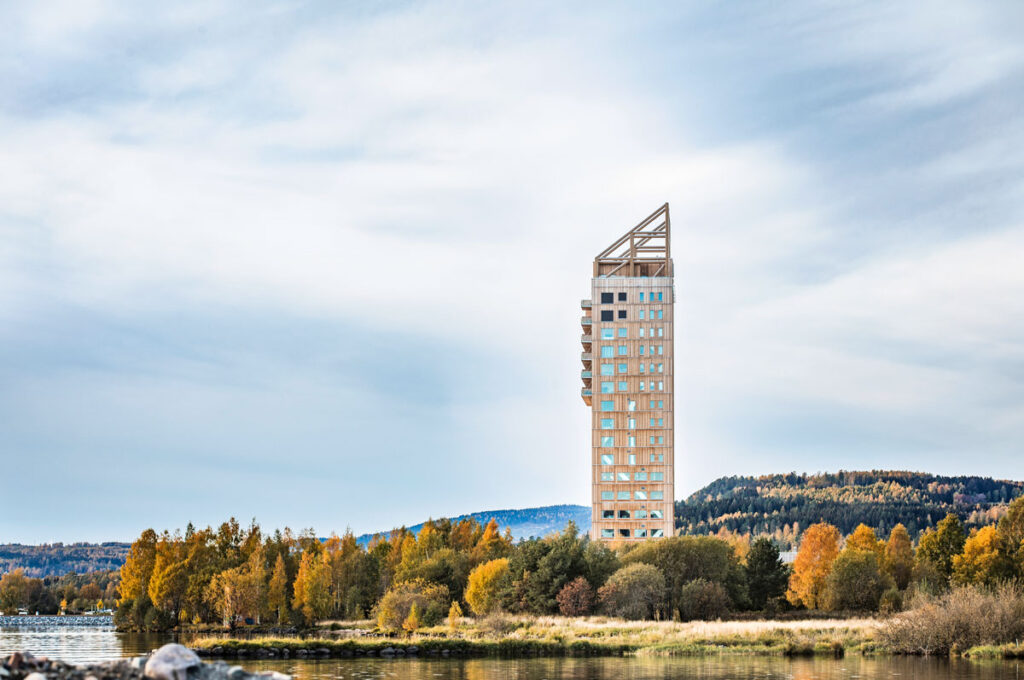
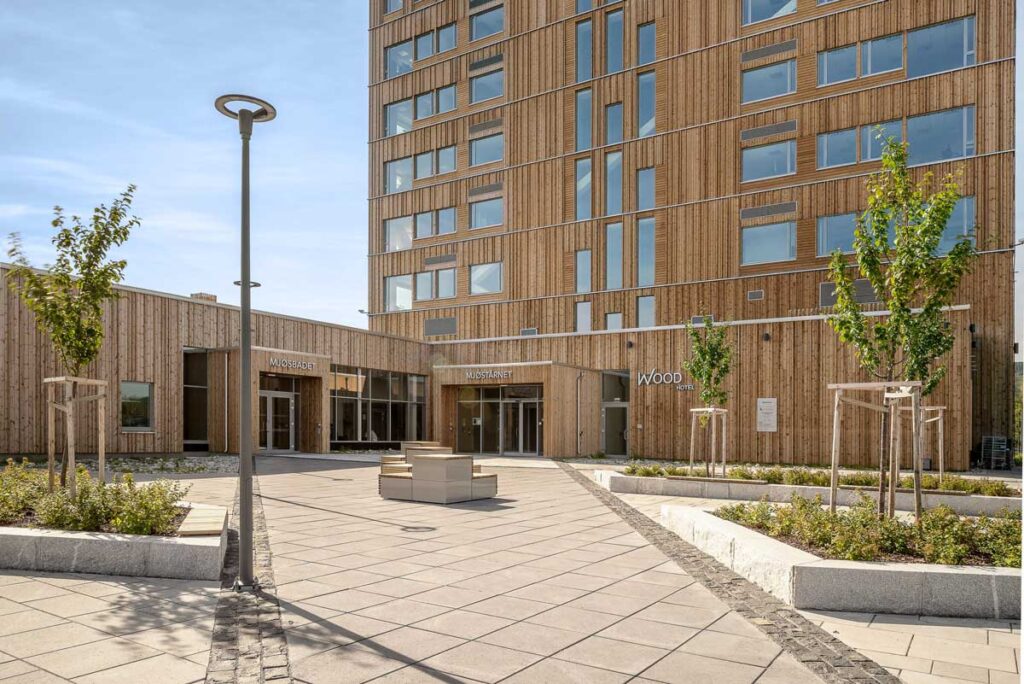
Around 107 km north of the Norwegian capital Oslo, in Brumunddal on the eastern shore of Lake Mjøsa, the Mjøstårnet skyscraper rises 18 storeys and around 85.4 metres above the landscape. It is now the tallest wooden tower block in Europe. Surrounded by dense forest and the tranquil lake, it exudes an almost meditative presence. The architecture firm Voll Arkitekter (Trondheim, Norway) created a building with a hotel (72 rooms), 33 flats, offices, a restaurant, conference rooms, a publicly accessible roof terrace with spectacular views and a swimming pool that almost merges with nature. The construction is based on glulam as the primary load-bearing structure, combined with cross-laminated timber for lift and stair shafts and balconies. Concrete slabs were added to the upper seven storeys to fulfil comfort and acoustic requirements.
A total of 11,300 m² of floor space was realised, including around 4,700 m² in the swimming pool hall in the extension. Around 4,000 cubic metres of wood were used for the timber construction, i.e. around 16,000 spruce trees, which were felled and processed regionally. In this form, the tower combines lightness with solidity and appears both natural and monumental at the same time. The surrounding landscape forms a clear framework that further emphasises the architectural effect of the tower.
The project has received numerous international awards (e.g. New York Design Award 2018, Structural Engineering Award 2021 from CBUTH) and emphasises that wood in building construction is far more than just a trend.
The cantonal administration building at Seetalplatz, Emmen - sustainable with a «heart of wood»
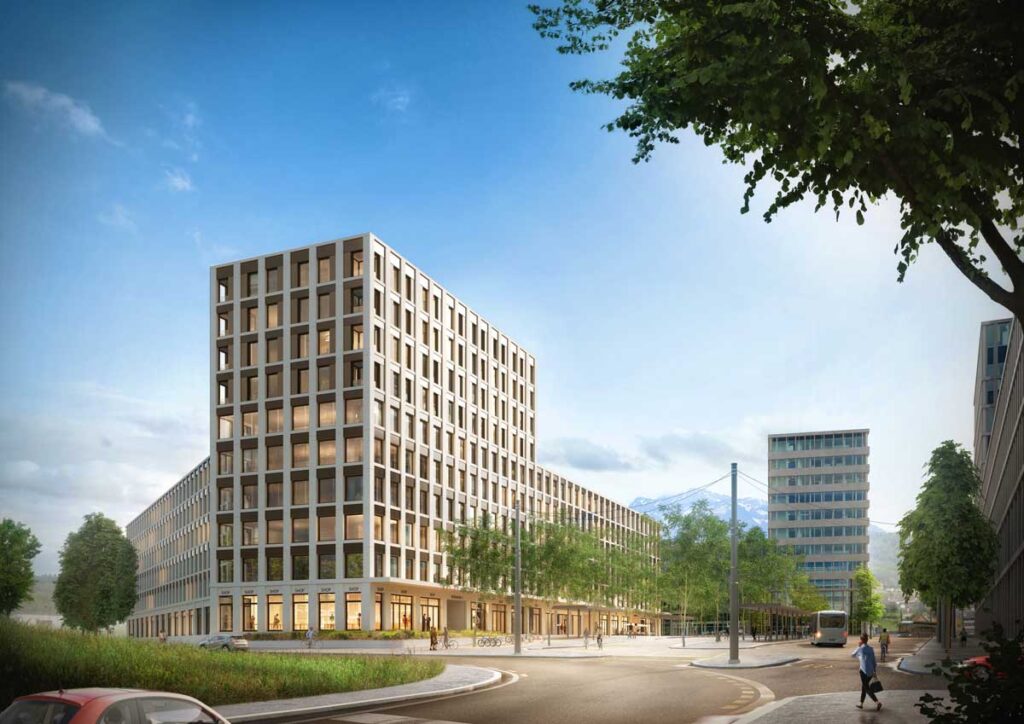
In the new Lucerne North centre, surrounded by the Reuss and Kleine Emme rivers, a «Smart City» will be created by 2026. At the centre is the cantonal administration building on Seetalplatz with an area of 41,000 m². Losinger Marazzi developed the sustainable building together with Max Dulder Architekten and timber engineer Pirmin Jung and is realising it as a total contractor for the canton of Lucerne. The plan is for a base building with five storeys, supplemented by a ten-storey tower block with an atrium, the «heart of wood». A good 1,420 cubic metres of wood, mainly spruce and fir, will be used in the hybrid structure and the entire façade construction.
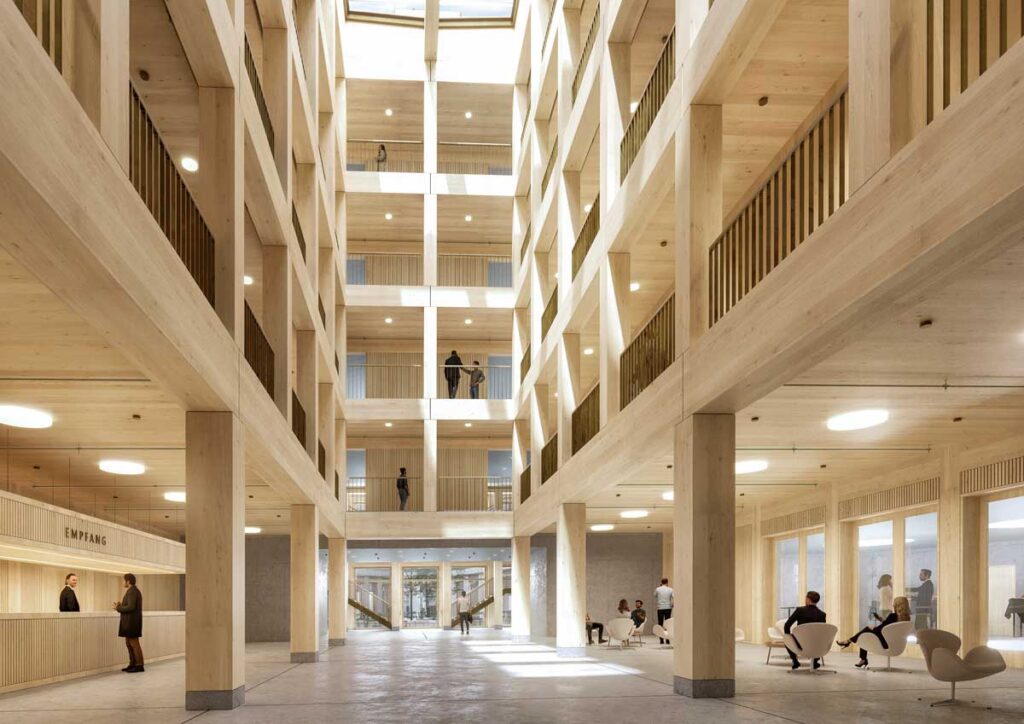
Since the ground-breaking ceremony in autumn 2023, construction work has progressed as planned, with the topping-out ceremony taking place in March 2025. The timber assembly work with a total of around 430 façade elements has now been completed. The prefabricated façade elements come from the workshops of Renggli AG in Schötz. The serial production of the elements ensures quality and speeds up assembly on site - and thus provides cost certainty.
The new cantonal administration building will bring 2,000 employees together under one roof, creating a central contact and advice centre. In addition to administrative offices, the building houses flats, restaurants and areas for third parties such as shops and a fitness centre.
The canton of Lucerne has expressly committed itself to ecological sustainability. This building is a flagship project in this respect. The use of wood is regional: the material comes exclusively from the Lucerne state forest, short distances from the forest to the sawmill strengthen regional cycles. Geothermal heating and cooling systems via a heating network, photovoltaics on the roof and parts of the façade as well as the targeted Minergie-P ECO and SNBS Gold standards emphasise the ecological strategy. Finally, mobility is flanked by the best public transport and cycle infrastructure as well as car sharing.
Wood plays a role not only as a design element, but also as an ecological and structural core. The idea is to establish the building project as a visible and tangible sign of a sustainable canton, i.e. energy-saving, low-carbon, modern, networked and future-oriented.
Expert opinion
«From a sustainability perspective, timber construction has a whole range of advantages. As a lightweight, biological building material, wood is a resource that is inherently low in CO₂, especially in comparison to concrete. There are also advantages in terms of the circular economy, such as the deconstructability of a timber structure.»
Lennart Rogenhofer
Chief Climate Officer & Head of Sustainable Engineering
Losinger Marazzi AG
High-rise buildings made of wood: modern, sustainable and efficient
These two projects show that timber in high-rise construction has long been more than just an aesthetic approach. The Mjøstårnet in Norway demonstrates how completely timber-based high-rise constructions work - with local added value, international appeal and architectural sophistication. In Emmen, the timber hybrid construction of the cantonal administration building represents a sensible combination of robustness, sustainability and efficiency. It focusses on regional recycling management and rapid, high-quality construction progress.
Wood opens up modern perspectives in building construction - solid, elegant and sustainable. These projects demonstrate an approach that harmonises architecture, the environment and society.
Share post